Korea E-7 Visa Refusal: Should You Rewrite the Employment Contract and Reapply?
BySangjin Ji, Administrative Attorney3 years of embassy visa practiceLinkedIn
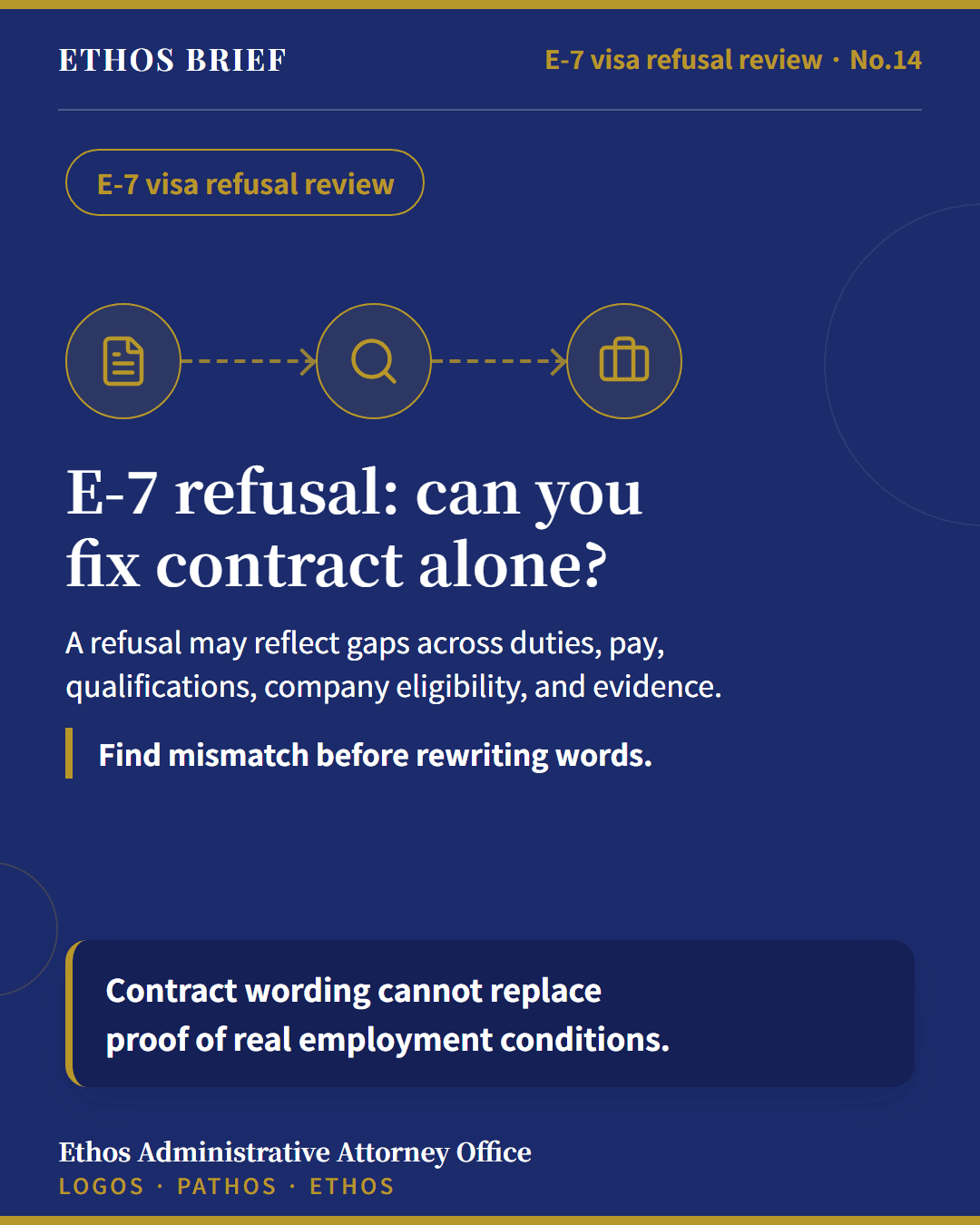
Your company applied for an E-7 visa to hire a foreign employee.
The position was decided, the employment contract was signed, and the required documents were submitted.
Then immigration refused the application.
Now the HR manager is looking at the contract again. Would increasing the salary or changing the job title make the next application successful?
Rewriting the employment contract alone will not necessarily resolve the reason for an E-7 refusal.
If the contract incorrectly records the terms actually agreed upon, the error should be corrected.
But if the proposed duties do not match the E-7 occupation applied for, or the employee or employer does not meet the applicable requirements, the underlying problem remains.
A different response may be needed if immigration misunderstood important facts or made a questionable discretionary assessment.
This is why the first document to examine after a refusal is not a newly drafted employment contract.
It is the immigration refusal notice.
The notice helps identify what application was refused, why immigration refused it, and when the decision was communicated.
Two possible courses of action must then be distinguished.
One is to prepare a new application after correcting genuine errors, meeting previously unmet requirements, or obtaining additional evidence.
The other is to consider whether the existing refusal itself should be challenged.
These are different procedures with different purposes and legal consequences.
An actual administrative appeal involving a change from D-10 to E-7 status illustrates why the distinction matters.
What Should HR Check in an E-7 Refusal Notice?
A statement that an E-7 visa application was refused does not necessarily explain which immigration procedure was involved.
For example, a foreign national already staying in Korea under D-10 status may apply to change their status of stay to E-7.
That is different from applying for a visa or a certificate for visa issuance through procedures involving an overseas applicant.
The responsible authority, notification procedure, consequences for continued stay, and possible routes for challenging the decision may differ.
Applications to change status of stay within Korea are governed by Article 24 of the Immigration Act (「출입국관리법」) and relevant provisions of its Enforcement Decree, including Articles 30 and 33.
When an employer receives a refusal notice, it should identify several matters before changing the employment contract:
- The applicant and the authority that issued the refusal
- The type of immigration application that was refused
- The stated reason for refusal
- The date on which the refusal was communicated
- Any departure deadline stated in the notice
- The foreign national's currently authorized status and period of stay
Each point may affect the company's next decision.
Suppose immigration refused an application because the employee's actual responsibilities did not correspond to the E-7 occupation selected.
Increasing the salary would not, by itself, resolve that discrepancy.
Conversely, if the application was refused because the proposed remuneration fell below the applicable wage requirement, adding more detail to the job description would not solve the salary problem.
Where the refusal notice provides only a brief explanation, HR should compare it with the employment contract, hiring justification, original application, and any supplementary documents submitted during examination.
The question is not simply which sentence should be rewritten.
It is why immigration declined to grant the requested permission.
Source: National Law Information Center, Immigration Act, Article 24; Enforcement Decree of the Immigration Act, Articles 30 and 33.
An Actual E-7 Refusal That Was Overturned in an Administrative Appeal
On July 18, 2017, an administrative appeal decision identified as 2017-00463 cancelled a refusal to permit a foreign national to change from D-10 job-seeking status to E-7 Specific Activities status.
The central issue was not the salary or job title in the employment contract.
The applicant had entered Korea in 2010 under D-2 student status and changed to E-7 status in 2014.
The applicant subsequently received a criminal fine of KRW 1.5 million for an assault-related offense.
Immigration became aware of the offense and issued a serious warning.
At first glance, the earlier criminal offense might appear to explain why a later immigration application was refused.
However, the immigration decisions made after that warning were significant.
Despite knowing about the offense, immigration granted an extension of stay in July 2015.
The applicant subsequently entered Korea again under E-7 status, received another extension, and obtained permission to change to D-10 status in August 2016.
In December 2016, the applicant signed an employment contract for work involving content production, translation, and interpretation, and applied to change back to E-7 status.
On December 28, 2016, immigration refused the application, referring in part to the earlier offense and the applicant's immigration compliance history.
The applicant challenged the refusal.
Why Did the Reviewing Body Cancel the Refusal?
The applicant argued, among other things, that relying again on an offense already addressed by the authorities was inconsistent with the prohibition against double punishment.
But the reviewing body did not base its decision simply on the conclusion that the earlier offense could never be considered again.
Instead, it examined the applicant's immigration history after the warning.
Several circumstances were relevant:
- The applicant had lived legally in Korea for an extended period.
- The applicant had obtained a master's degree and participated in volunteer activities.
- Immigration had granted extensions and a subsequent change of status despite knowing about the earlier offense.
- There had been no further criminal offense or Immigration Act violation after the warning.
- Those previous approvals had contributed to the applicant's legitimate expectations.
Immigration had already taken the earlier offense into account when granting subsequent permissions.
The reviewing body considered it unreasonable to rely again on the same past circumstances, without a meaningful change in circumstances, to impose an unfavorable decision.
It did not necessarily find that the refusal clearly violated an express statutory provision.
Rather, after considering the relevant circumstances and legitimate expectations, it found the refusal unreasonable and cancelled the December 28, 2016 decision.
The decision cancelled the previous refusal. It did not automatically grant a new E-7 status of stay.
Nor did it establish that immigration authorities are prohibited from considering past offenses in every future application.
The result depended on the particular immigration history, previous official decisions, and circumstances examined in that case.
It would also be incorrect to assess the applicant's 2016 employment contract against the wage requirements introduced for 2026.
The applicable legal standards must be considered in their proper time period.
What Can an Employer Learn From This Case?
An employer facing an E-7 refusal should not assume that the employment contract contains the entire explanation.
If immigration relied on the applicant's past conduct or immigration history, the employer and employee may need to examine earlier approvals, warnings, and subsequent changes in circumstances.
Rewriting the employment contract would not change those historical facts.
The relevant question may instead concern how immigration assessed them when making its refusal decision.
Source: National Law Information Center, Administrative Appeal Decision 2017-00463, "Request to Cancel a Refusal of Permission to Change Status of Stay" (July 18, 2017; appeal upheld).
Does Meeting the Documentary Requirements Guarantee Approval?
No.
A change of status of stay is not necessarily granted merely because the applicant has submitted the required documents.
The Korean Supreme Court addressed the legal nature of permission to change status of stay in Case 2015Du48846, decided on July 14, 2016.
The Court explained that permission to change status grants authority to undertake activities associated with a different immigration status.
The competent authority may exercise discretion when considering the applicant's eligibility, purpose of stay, and implications for the public interest.
Meeting statutory requirements therefore does not mean approval is automatic.
However, discretion does not allow immigration authorities to disregard the legal limits on their decision-making.
A decision may be unlawful where, for example, the authority makes a serious error in its factual assessment or acts contrary to the principles of proportionality or equality.
The Supreme Court decision itself was not an E-7 case.
It concerned a different change-of-status refusal and addressed the general legal principles governing discretionary immigration decisions.
The Supreme Court set aside the lower court's judgment and remanded the case for further consideration.
That outcome is known as a remand. It did not, by itself, determine whether the applicant ultimately received immigration permission.
The administrative appeal involving E-7 status discussed earlier also referred to the Supreme Court's legal reasoning on discretion.
For employers, the practical distinction is important.
An application supported by complete documents is not automatically approved.
But a refusal is not necessarily lawful or reasonable simply because the immigration authority has discretion.
HR should examine both whether the applicant satisfies the relevant conditions and how immigration evaluated the submitted facts and prior immigration history.
Source: Supreme Court of Korea, Decision 2015Du48846, July 14, 2016, "Revocation of Refusal to Extend or Change Immigration Status" (remanded).
When Might Correcting an Employment Contract Support a New Application?
A new application may be worth considering where the company has genuinely met a requirement that was previously unmet, or where it can correct an error in the submitted documentation.
Consider a salary discrepancy.
Suppose an employer and foreign employee genuinely agreed on an annual salary of KRW 32,000,000.
However, the employment contract mistakenly states KRW 30,000,000.
The difference matters because E-7 applications are subject to wage requirements that depend on the relevant category and occupation.
Under Ministry of Justice Notice No. 2025-406, issued on December 29, 2025, the general annual wage requirement for E-7-1 professional workers in 2026 is KRW 31,120,000 or more.
The stated requirements apply from February 1 through December 31, 2026.
Occupations for which the Minister of Justice has established separate wage requirements are subject to those specific standards.
If the Agreed Salary Was KRW 32,000,000
The company should establish that KRW 32,000,000 was the amount genuinely agreed upon.
If the contract mistakenly recorded a lower figure, the error should be corrected appropriately.
The employer should also compare the hiring justification and other application materials to identify any inconsistent figures.
When considering a new application, the company may need to explain which information was incorrect and provide documentation showing the accurate employment conditions.
Even if the applicable wage threshold is satisfied, other E-7 requirements remain relevant.
A sufficient salary alone does not guarantee approval.
If the Actual Agreement Was KRW 30,000,000
The position is different.
For an E-7-1 occupation subject to the general 2026 requirement, an actual annual salary of KRW 30,000,000 falls below the KRW 31,120,000 threshold.
Changing the contract to show KRW 32,000,000 without changing the genuine employment agreement would not establish compliance.
The employer and employee must consider the remuneration they will actually agree to and pay.
If they change the employment conditions, the requirements for specifying employment terms under Article 17 of the Labor Standards Act must also be considered.
The distinction is between correcting an inaccurate document and changing the actual employment conditions to meet an applicable requirement.
These are not interchangeable actions.
Source: Ministry of Justice Notice No. 2025-406, "2026 Wage Requirements for Specific Activities (E-7) Status of Stay" (December 29, 2025); National Law Information Center, Labor Standards Act, Article 17.
What If the Refusal Concerns Job Duties or Eligibility?
Salary is only one possible issue.
An E-7 application may also raise questions about whether the employee's actual responsibilities fall within the occupation selected for the application.
Suppose a contract describes the employee's position as overseas sales.
However, the work the employee will mainly perform is domestic customer support.
Changing the job title to something more specialized would not change the actual responsibilities.
The employer should examine whether those responsibilities correspond to the E-7 occupation applied for.
Now consider a different situation.
The employee will genuinely develop overseas clients and participate in export contract negotiations, but the original application did not explain those responsibilities clearly.
A more detailed job description and existing business records may help demonstrate the actual role.
The two cases require different assessments.
In the first, the intended duties and selected occupation may not match.
In the second, the duties may be appropriate, but the evidence or explanation may be insufficient.
Qualifications and Employment History
A similar distinction applies to the foreign employee's academic qualifications and professional experience.
If the employee has the experience required for the applicable E-7 occupation but the submitted certificate does not adequately describe the employment period or duties, further supporting records may be relevant.
If the employee does not satisfy the applicable qualification requirements, describing that person as a specialist in the contract will not create missing qualifications.
Employer Eligibility
The employing company's circumstances may also affect the application.
Certain E-7 occupations have specific employer requirements or employment restrictions.
The same company-size requirement, workforce ratio, or occupation-specific wage exception does not apply to every E-7 occupation.
The employer may need to compare its actual business activities and supporting records with the requirements applicable to the proposed position.
Article 23 and Attached Table 1-2 of the Enforcement Decree of the Immigration Act provide part of the statutory framework concerning employment activities and immigration status.
A new application should address what was genuinely missing or incorrect in the previous application.
Merely giving the same employment arrangements a different description does not remove an existing eligibility problem.
Source: National Law Information Center, Enforcement Decree of the Immigration Act, Article 23 and Attached Table 1-2.
Reapplying and Challenging a Refusal Are Different Procedures
A new application asks immigration to examine a request based on the applicant's current circumstances, corrected employment conditions, and supporting documentation.
Challenging an existing refusal concerns whether the earlier decision was unlawful or unreasonable.
For example, where an applicant genuinely failed to meet an applicable salary requirement, the employer may need to address that requirement before considering a new application.
But where immigration allegedly misunderstood important facts or failed to properly consider relevant circumstances, examining the grounds for the original refusal may be necessary.
The 2017 administrative appeal involving D-10 and E-7 illustrates the second situation.
The applicant's earlier warnings and approvals were relevant to the assessment of the refusal.
However, an earlier immigration approval does not guarantee approval of a subsequent application.
Actual changes in circumstances and the rules applicable to each application remain important.
Time Limits for Challenging an Administrative Decision
If an applicant is considering challenging a refusal, the notification date may be important.
Under Article 27 of the Administrative Appeals Act (「행정심판법」), an ordinary administrative appeal seeking revocation must generally be filed within 90 days of becoming aware of the disposition.
In principle, it cannot be filed more than 180 days after the disposition, subject to statutory exceptions.
The legislation also contains provisions concerning unavoidable circumstances, justifiable reasons, and notification of appeal periods.
For an action seeking revocation under Article 20 of the Administrative Litigation Act (「행정소송법」), the general time limits are 90 days from becoming aware of the disposition and one year from the disposition.
Where a legally valid administrative appeal has first been pursued, additional rules may determine the starting date by reference to the service of the written appeal decision.
Statutory exceptions, including those concerning justifiable reasons, must also be considered.
These are general time limits for challenging administrative dispositions.
They are not the deadlines for submitting a new E-7 application.
Nor should the same administrative appeal procedure be assumed to apply automatically to both an in-country change-of-status refusal and an overseas visa-related decision.
The nature of the actual decision and the relevant legal procedure must be established.
Preparing a revised contract or considering a new immigration application does not automatically suspend or restart the time limit for challenging the previous refusal.
An employer that concentrates exclusively on rewriting the application documents may therefore overlook a separate procedural deadline.
What Work Can an Administrative Attorney Perform?
Preparing and submitting administrative documents for an E-7 reapplication must be distinguished from formally representing a person in proceedings challenging an existing refusal.
Article 2 of the Administrative Attorney Act (「행정사법」) provides for certain document preparation and submission activities undertaken on a client's behalf, while excluding work restricted by other laws.
Article 18 of the Administrative Appeals Act separately governs who may act as a representative in administrative appeal proceedings.
Holding an Administrative Attorney qualification does not, by itself, confer an unrestricted right to represent a client in those proceedings.
The preparation or submission of documents connected with a challenge must likewise be considered under the legislation governing the particular procedure.
Representation in administrative litigation requires separate legal authority.
Accordingly, an employer should distinguish administrative document preparation for a new E-7 application from representation in a challenge to an existing refusal.
Source: National Law Information Center, Administrative Attorney Act, Article 2; Administrative Appeals Act, Articles 18 and 27; Administrative Litigation Act, Article 20.
Does an Appeal Period Allow the Employee to Remain in Korea?
Not automatically.
A deadline for challenging an immigration refusal and a departure deadline stated in the refusal notice have different purposes and legal effects.
They must be checked separately.
The General Departure Deadline and Its Exceptions
Article 33(2) of the Enforcement Decree of the Immigration Act addresses notification where permission to obtain a status of stay, change status, or extend the period of stay is refused.
As a general rule, the departure deadline specified in the relevant notice is set within a period not exceeding 14 days from issuance of the notice.
However, the provision also allows an exception.
Where the Minister of Justice considers it necessary, the departure deadline may be set as the expiration date of the period of stay already authorized.
In addition, under the latter part of Article 33(1), immigration may refuse permission to change status while allowing the foreign national to remain under the status already granted.
In such a case, the notice may omit a departure deadline.
Consequently, it would be inaccurate to say that every foreign national whose E-7 application is refused must leave Korea exactly 14 days later.
It would also be unsafe to assume that an unexpired D-10 period always permits continued stay without checking the refusal decision.
The actual notice, the currently authorized status, and the authorized period of stay must be considered together.
An Appeal Deadline Is Not an Immigration Permission
The ordinary 90-day and 180-day periods discussed earlier concern an administrative appeal against a decision.
They do not automatically extend any departure deadline.
Similarly, preparing a new application or an administrative appeal does not itself establish permission to remain in Korea.
The employee's immigration status and the conditions stated by the responsible authority must be checked separately.
Can the Employee Start E-7 Work After Reapplying?
The right to undertake employment activities is another distinct question.
Under Article 24 of the Immigration Act, a foreign national wishing to undertake activities corresponding to a different status of stay must, as a general rule, obtain permission to change status beforehand.
Submitting a new E-7 application after a refusal does not itself authorize the employee to begin E-7 employment.
Any activities permitted under the person's existing status, or separately authorized, must be assessed under the relevant rules.
If the employer has already planned a starting date, it should confirm when the proposed employment activities may legally begin before revising that date in the contract.
Where the departure deadline or permission to continue staying is unclear, the employee should check the refusal notice with the responsible immigration office.
Source: National Law Information Center, Immigration Act, Article 24; Enforcement Decree of the Immigration Act, Article 33.
What Should the Company Prepare Before Deciding Whether to Reapply?
Return to the HR manager who reopened the employment contract immediately after receiving the refusal.
This time, the manager starts with the refusal notice.
The employment contract is placed beside it, together with the application and documents previously submitted.
The company should determine what immigration actually refused and why.
A useful comparison includes:
- The application type, stated grounds for refusal, date of notification, and departure instructions
- The salary and job duties in the employment contract and hiring justification
- The employment terms genuinely agreed upon by the employer and employee
- Any documents submitted in response to earlier supplementation requests
- Academic and professional experience records relevant to the selected E-7 occupation
- Existing business records relevant to any employer eligibility requirements
- Previous immigration approvals or warnings, where they are relevant to the refusal
Different findings lead to different next steps.
If the employee did not satisfy an applicable salary or qualification requirement, the employer should identify what must genuinely change before considering another application.
If there was an error in the submitted documents, the company should establish which record was accurate and why the others differed.
If the relevant issue concerns earlier immigration decisions or the authority's assessment of facts, the previous administrative records may need to be examined.
The company can begin by identifying dates, comparing the documents it possesses, and determining what evidence is missing.
However, deciding whether the selected E-7 occupation meets the applicable conditions, what has materially changed for a new application, or whether a previous refusal can be challenged may require an individual legal assessment.
There is also a distinction between the work the employer can undertake internally and administrative document preparation that may be assigned to a professional.
Where legally permitted, drafting a revised hiring justification and other documents for an E-7 reapplication, or submitting the relevant administrative paperwork, can be considered as separately scoped paid work.
Formal representation in a challenge to a refusal must be undertaken by a professional with the legal authority required for that procedure.
A well-written employment contract is an important part of an E-7 application.
But it cannot replace the employee's actual qualifications, the employer's eligibility, or evidence of the work the employee will genuinely perform.
Once an application has been refused, the company's first priority should be to understand the grounds for refusal rather than simply produce a more persuasive version of the same contract.
Ethos Administrative Attorney Office offers a free preliminary review of the E-7 refusal notice, existing employment contract, hiring justification, and available supporting records to help distinguish documentation errors, insufficient evidence, and substantive E-7 eligibility concerns, identify what additional materials should be checked before reapplying, and clarify when assessment by a professional legally authorized to handle a challenge to the refusal may be appropriate.
Three-line summary
Rewriting an employment contract after an E-7 refusal does not automatically resolve the reason for refusal. The actual employment conditions and eligibility requirements must be examined.
Correcting unmet conditions or missing evidence is different from challenging an immigration authority's factual or discretionary assessment. A new application and a challenge to an existing refusal are separate procedures.
Start with the refusal notice, including the grounds for refusal, notification date, departure instructions, and current immigration status, before deciding what documents or procedures are needed next.