New Program at a Korean Nonprofit: Do You Need a New Entity, an Articles Amendment, or Donation Registration?
BySangjin Ji, Administrative Attorney3 years of embassy visa practiceLinkedIn

The board of the Ethos Scholarship Foundation is meeting about a new youth career education program it wants to launch next year. The secretary general has budgeted KRW 15 million for the first year and plans to collect donations through the foundation's website and social media.
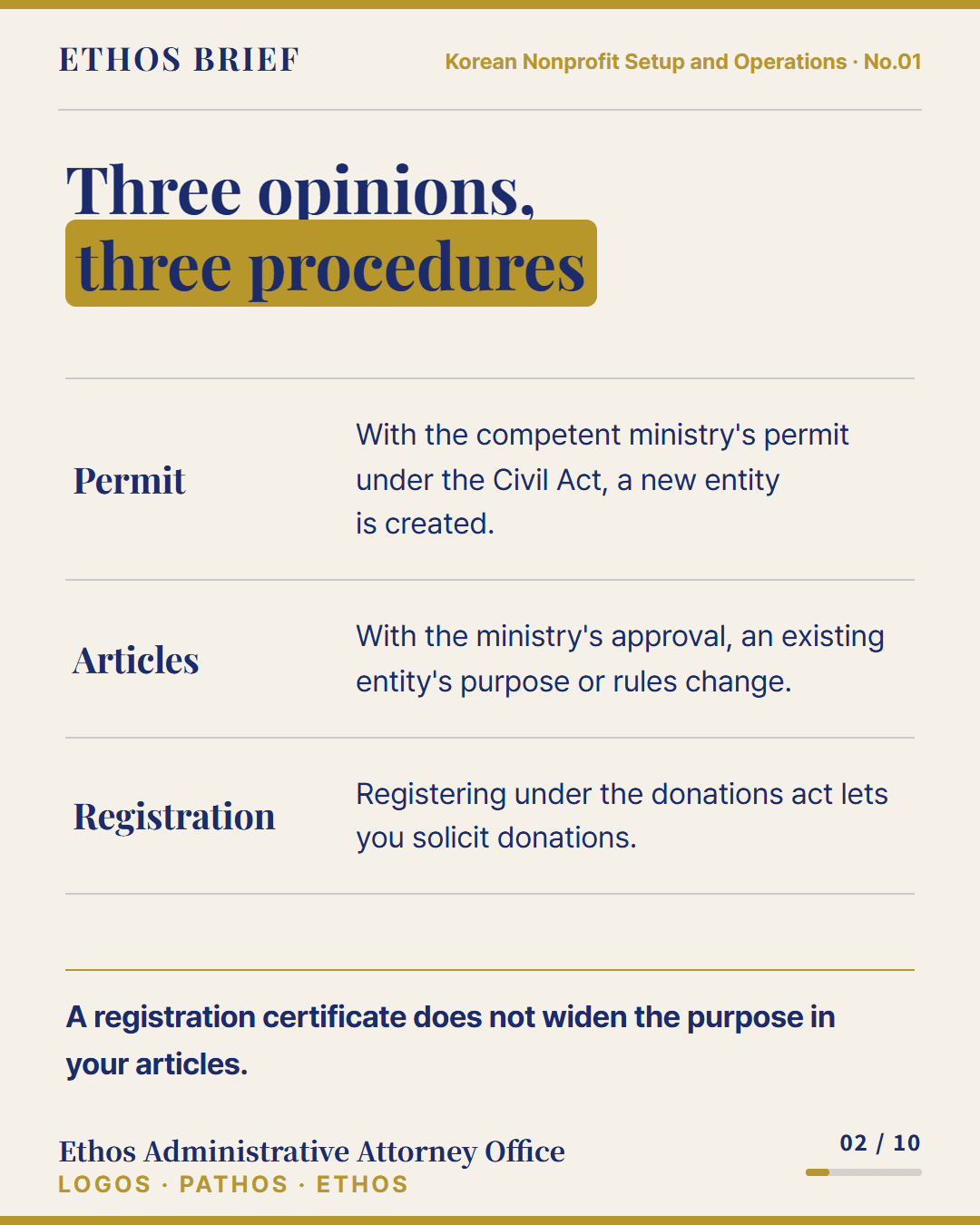
The directors disagree. One suggests setting up a separate legal entity because career education is a different kind of work. Another says the foundation only needs to amend its articles of incorporation. A third says the foundation has registered a fundraising campaign before, so it only needs to register again. They are talking about three different procedures: a permit to establish a corporation, an amendment to the articles, and registration of a donation campaign.
The short answer: the foundation does not need a new entity. It needs to check its articles first and then register the fundraising campaign. The two steps have an order, and because it is a foundation (a corporation built on property rather than members), there are extra conditions to confirm.
Three procedures, three legal bases, different agencies
- Establishment permit: Article 32 of the Civil Act (「민법」), granted by the competent ministry, creating a new legal entity.
- Articles amendment: Article 45 of the Civil Act for foundations, approved by the competent ministry, changing an existing entity's purpose or rules.
- Donation registration: Article 4 of the Act on the Collection and Use of Donations, filed with a registration authority, allowing donations to be solicited for a stated purpose, period, and amount.
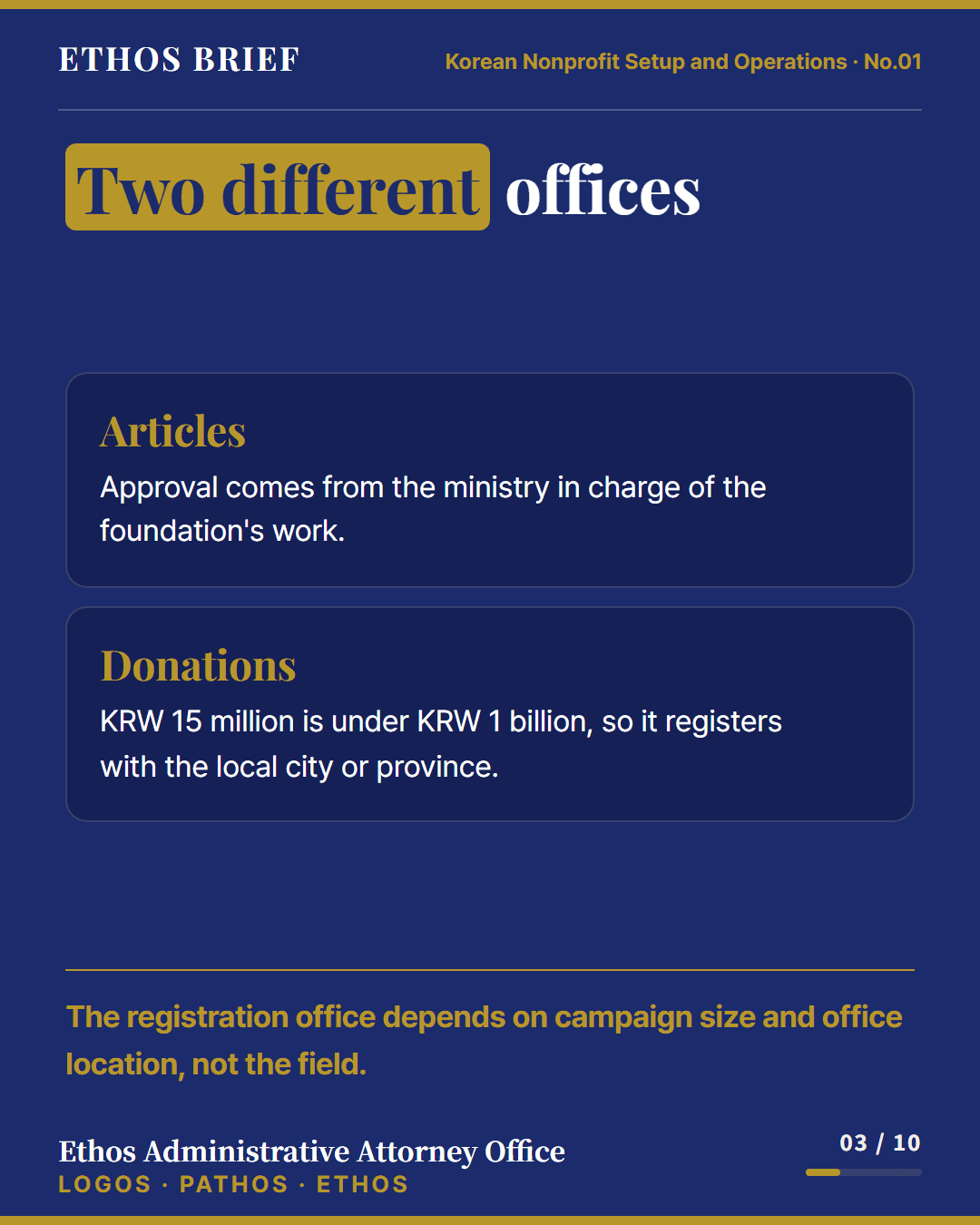
The competent ministry is the agency in charge of the corporation's line of work. It supervises the corporation after establishment (Civil Act, Article 37), so an articles amendment also needs its approval (Civil Act, Article 45(3) and Article 42(2)).
Donation registration is decided differently. Under Article 2 of the Enforcement Decree of the donations act, campaigns over KRW 1 billion register with the Minister of the Interior and Safety, and others with the city or provincial governor where the organizer's main office is located. So for the same program, the foundation may file with two different offices: the articles amendment with its competent ministry and the KRW 15 million campaign with its provincial or metropolitan government.
The two agencies review different things. Under Article 4(4) of the donations act, the registration authority checks whether the campaign plan serves the public interest and whether the applicant is disqualified. A registration certificate does not widen the purpose clause in the articles, and an approved articles amendment does not exempt a campaign of KRW 10 million or more from registration.
Does a new program require a new entity?
Not by itself. The first question is whether the current articles already cover the program. A separate entity makes sense only when even an amendment cannot cover the program, or when there is a reason to run it with different people or property.
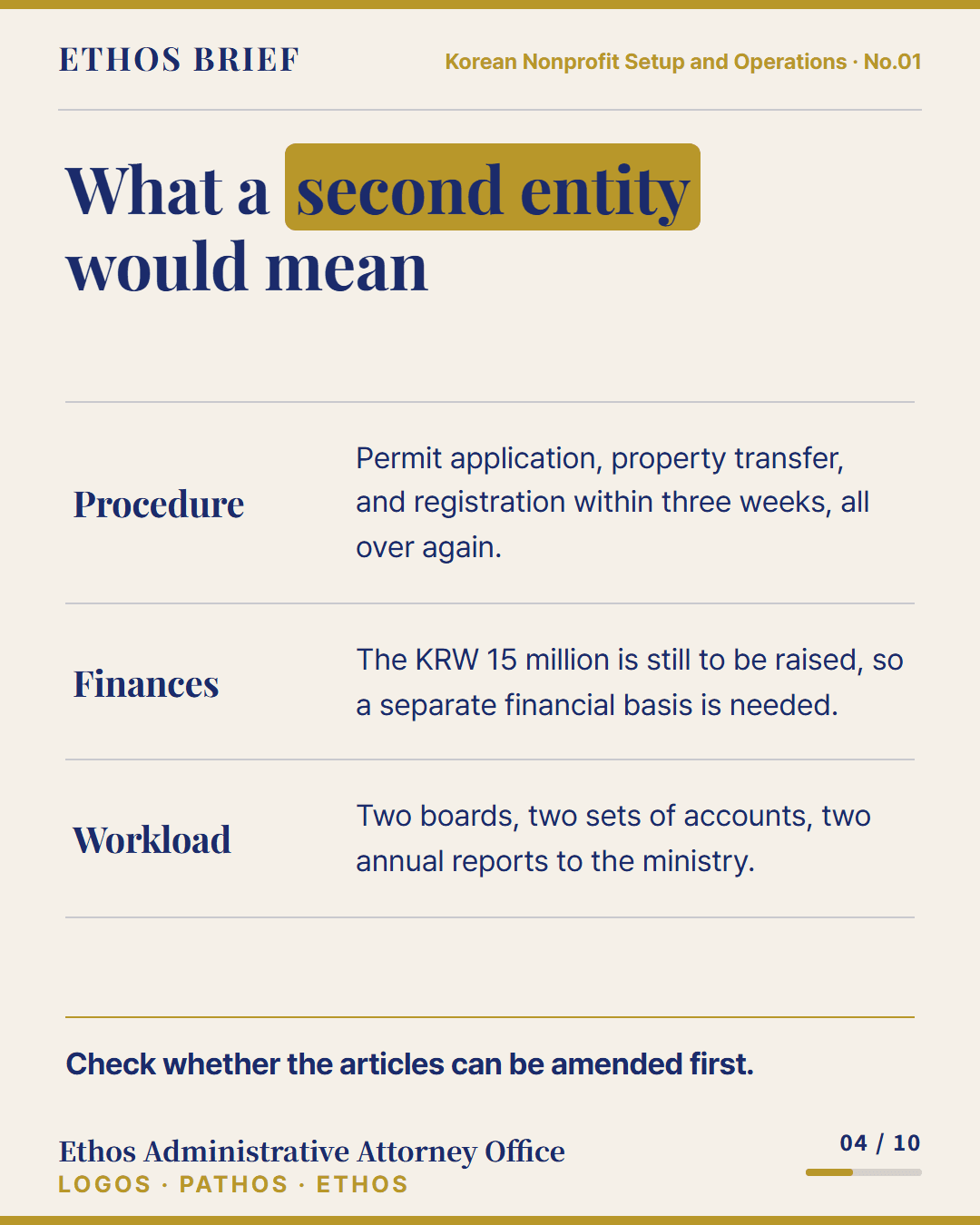
Setting up a new entity is a large undertaking. Under the Ministry of the Interior and Safety's rule on nonprofit corporations, for example, a new entity must apply with its founders' list, articles, property list, business plan and budget, officers' acceptances, and founding meeting minutes (Article 3); pass review of feasibility, capacity, financial basis, and name (Article 4(1)); transfer property and file proof within one month (Article 5(1)); register within three weeks of the permit (Civil Act, Article 49(1)), the point at which it legally comes into existence (Civil Act, Article 33); report within 10 days of registration (Article 5(2)); and file annual reports within two months after each fiscal year (Article 7).
For the foundation, the first-year budget of KRW 15 million is money it still has to raise, so a new entity would need its own financial basis for the permit review. It would also mean two boards, two sets of accounts, and two sets of annual reports.
What to check in the articles
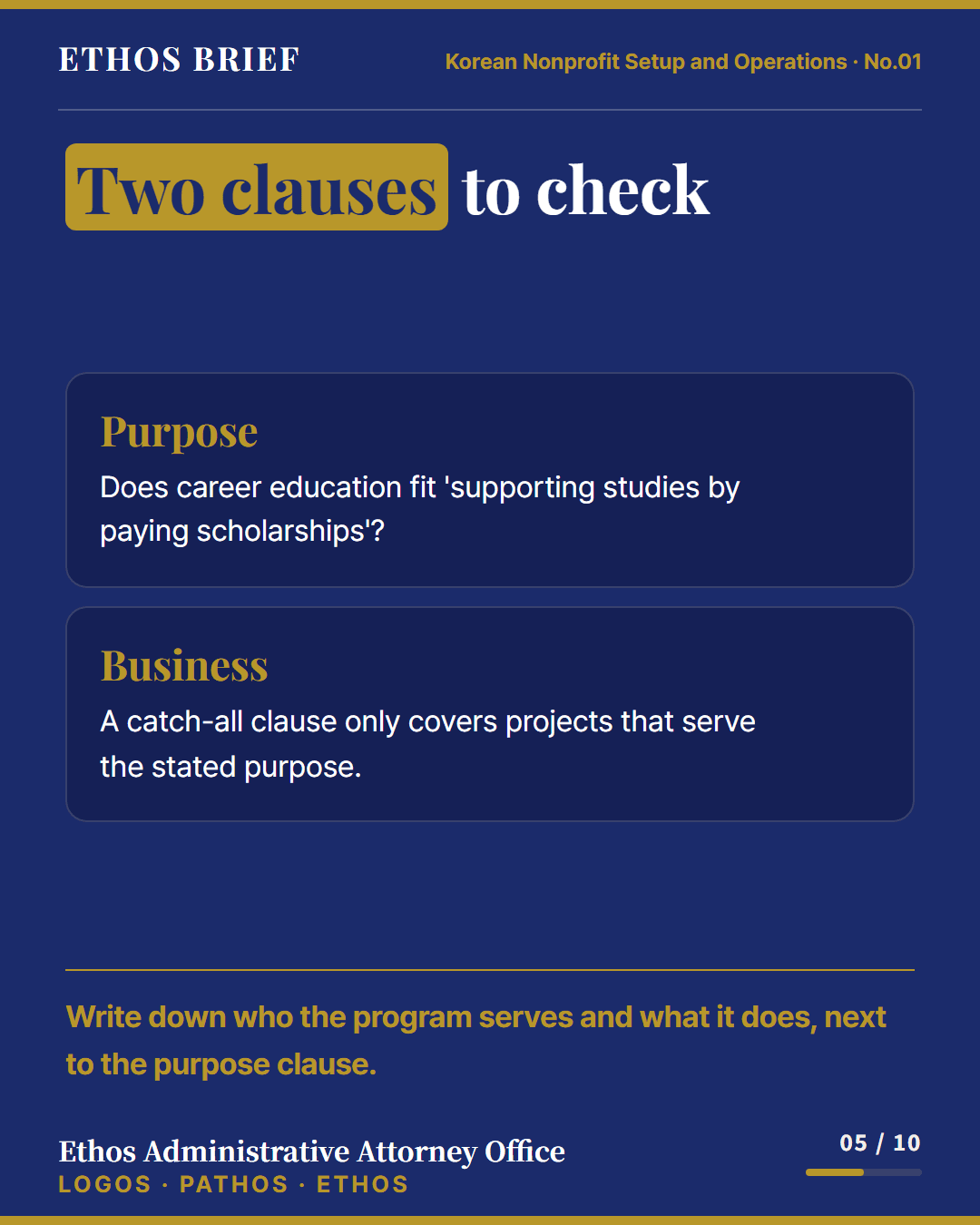
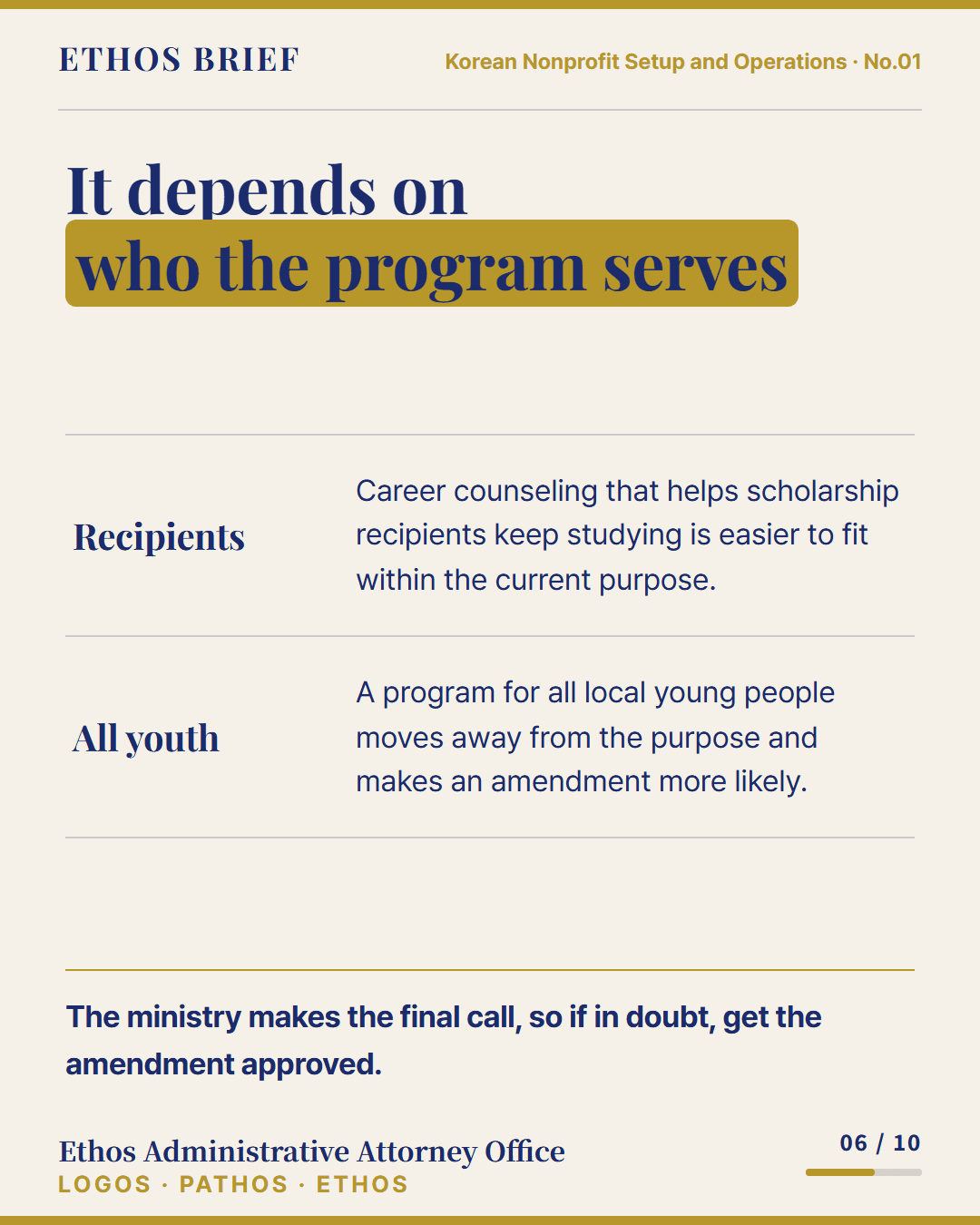
The articles come before the bank account. Suppose the purpose clause reads that the foundation "supports the studies of students in financial need by paying scholarships," and the business clause lists "scholarships" and "other projects needed to achieve the purpose." The catch-all wording only covers projects that serve that stated purpose. Career counseling that helps scholarship recipients continue their studies is easier to fit within it. A career experience program for all local young people moves further from the purpose and makes an amendment more likely. The competent ministry makes the final call, so if in doubt, getting the amendment approved avoids later disputes.
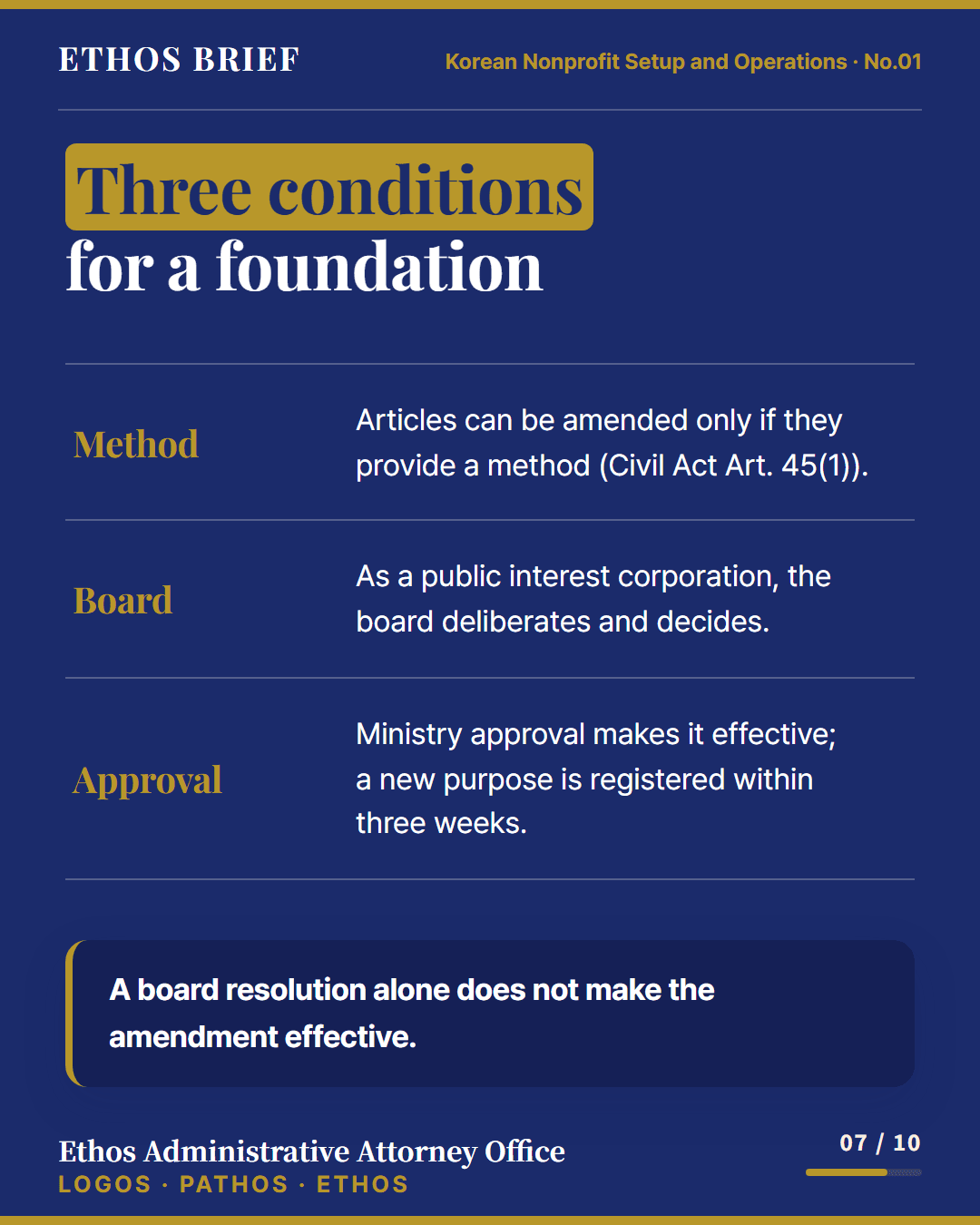
Foundations face stricter amendment rules than membership associations. An association can amend its articles with the consent of two thirds of all members (Civil Act, Article 42(1)). A foundation has no members' meeting, so under Article 45(1) its articles can be amended only if the articles themselves provide a method for doing so. Either way, an amendment has no effect without the competent ministry's approval.
A scholarship foundation is also a public interest corporation under the Act on the Establishment and Operation of Public Interest Corporations and its Enforcement Decree (Article 2(1)(1) and 2(2)). That Act requires the articles to include provisions on amendment (Article 3(1)(8)) and requires the board to deliberate and decide on amendments (Article 7(1)(2)).
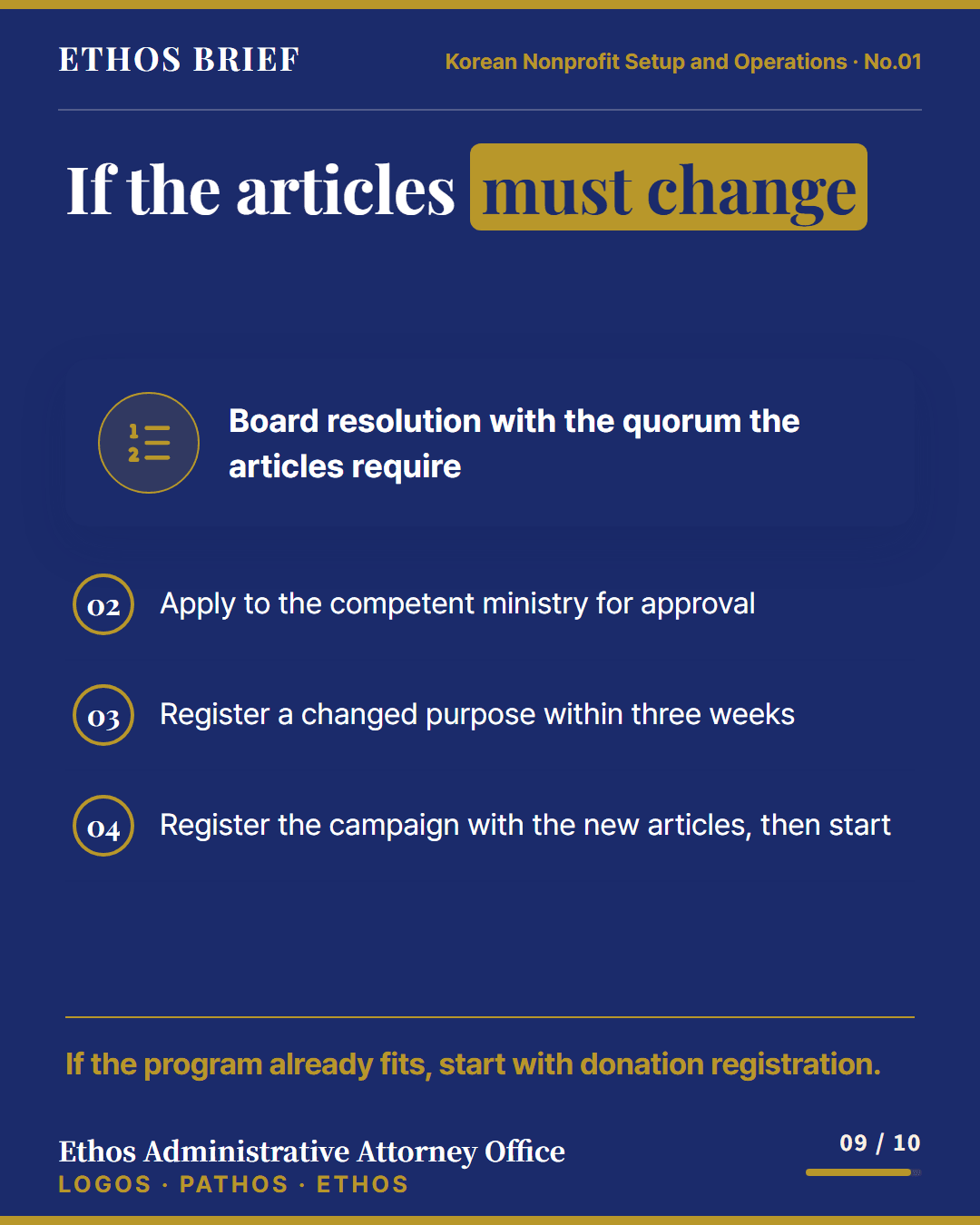
After the board resolution, the foundation applies to the competent ministry. The Interior Ministry rule, for example, requires a statement of reasons, the amended articles with a comparison table, and the relevant board minutes (Article 6(1)), and the ministry is to notify its decision in writing within 10 days absent special reasons (Article 6(2)). Because the purpose is a registered item (Civil Act, Article 49(2)(1)), a change in purpose must be registered within three weeks (Civil Act, Article 52). A board resolution alone does not change the articles; only after approval can the program run under the amended articles.
Does an existing corporation still need donation registration?
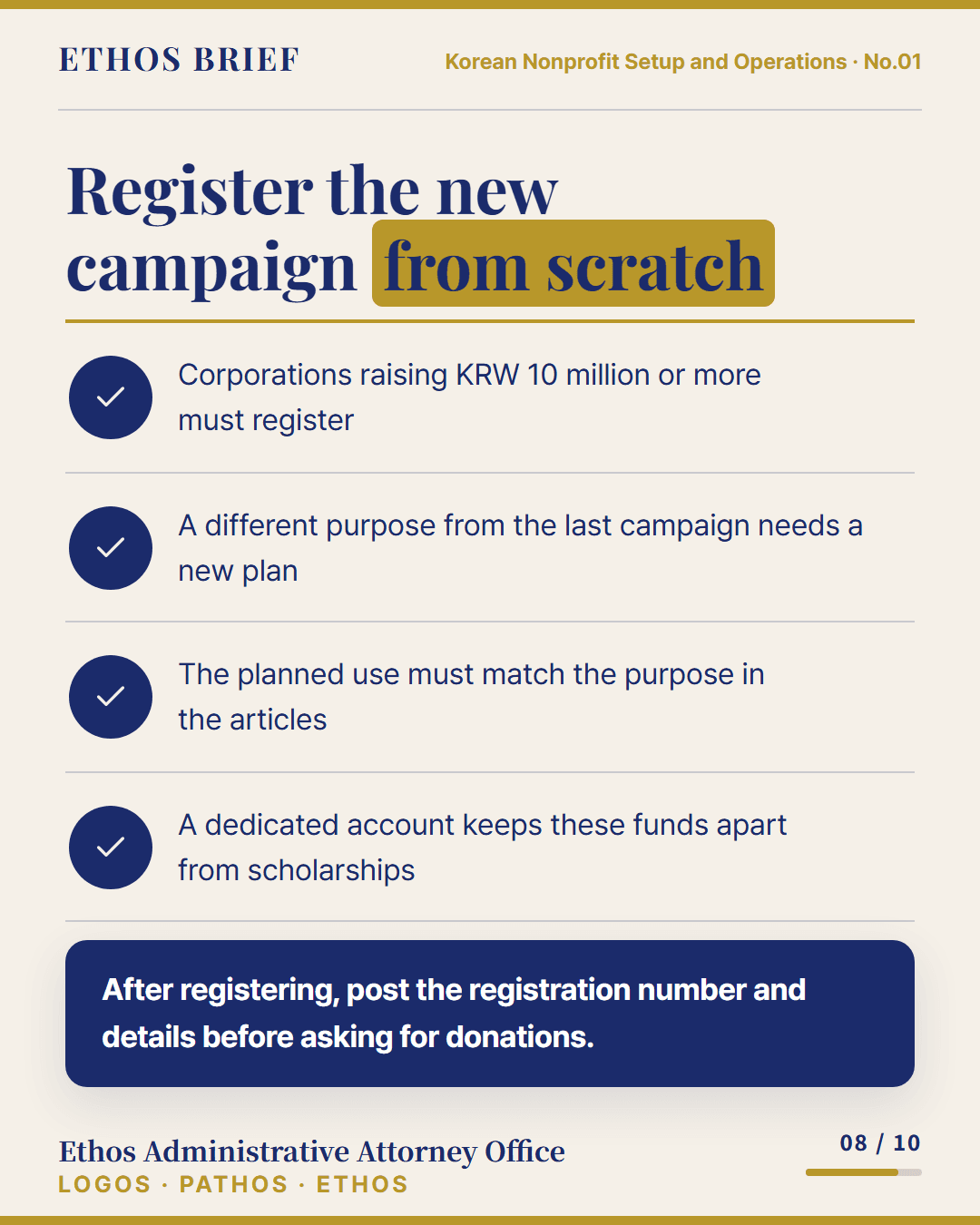
Yes. Article 4(1) of the donations act requires anyone who plans to solicit donations above the threshold set by decree, KRW 10 million, to prepare a collection and use plan and register it. The KRW 15 million target is above that line. The earlier scholarship campaign has ended and had a different purpose, so the foundation needs a new plan for career education. The old certificate and plan are still useful as a model.
The new plan covers the purpose, target amount, method, a collection period of up to one year, expected costs and how they are funded, how and by when the money will be used, and a dedicated bank account. The intended use must match the purpose clause in the articles, which is why the articles come first. The dedicated account keeps these donations separate from scholarship donations and becomes the evidence when the use of funds is reported.
After registration, Article 4(6) requires the organizer to show donors the registration authority and number, the purpose, whether tax benefits apply, the share used for collection costs, and how to check results. Soliciting a campaign that requires registration without registering can lead to penalties under Article 16(1)(1) of up to three years' imprisonment or a fine of up to KRW 30 million, so registration comes before any donation notice goes online.
The order of steps
Two questions sort out most cases: is the group already a corporation, and does it plan to raise KRW 10 million or more in donations rather than membership dues? A members-only group funded by dues does not raise donations under the act (Article 2(2)(a)). An unincorporated group can still register a campaign in its own name. A group that needs to hold property and continue as the same body regardless of its leader can consider incorporation. An existing corporation planning a new campaign, like this foundation, starts from its articles.
When an amendment is needed, the timeline runs backward from the launch date: board resolution, ministry approval, registration of the changed purpose within three weeks, then donation registration, because the application must attach the articles and the account book, and the authority checks the corporate registry (Enforcement Decree, Article 4(2), Article 3(2) and (5)). If the program already fits the articles, the foundation can go straight to registration.
What you can do yourself, and where a review helps
The secretary general can pull out the articles, the earlier registration certificate and plan, and the new program's plan and budget, mark the purpose clause, check whether the target is KRW 10 million or more, and set up a separate account. A closer review helps when it is unclear whether the program fits the purpose clause, whether the amendment provision covers a change of purpose, or when the amendment and the new registration must run at the same time and the documents have to match.
If you send your current articles and the new program plan, along with any earlier registration certificate and plan, the Ethos Administrative Attorney Office will use a free preliminary review to tell you whether you are at the permit, amendment, or registration stage, which order to follow, and what else to gather.
Three-line summary
Establishing a nonprofit corporation (Civil Act, Article 32) and registering a donation campaign (donations act, Article 4) are separate procedures, and an existing corporation raising KRW 10 million or more still needs to register.
Before setting up a new entity for a new program, check whether the current articles' purpose already covers it.
A foundation can amend its articles only by the method its articles provide, and a scholarship foundation needs a board decision and the competent ministry's approval for the amendment to take effect.